If this message is not displayed properly, click here please.

Climate Decisions, Energy Transitions, and What Comes Next 

Welcome to the December 2025 Edition of SIPET Connect, where we close the year by looking at how global climate politics and regional action are evolving.  

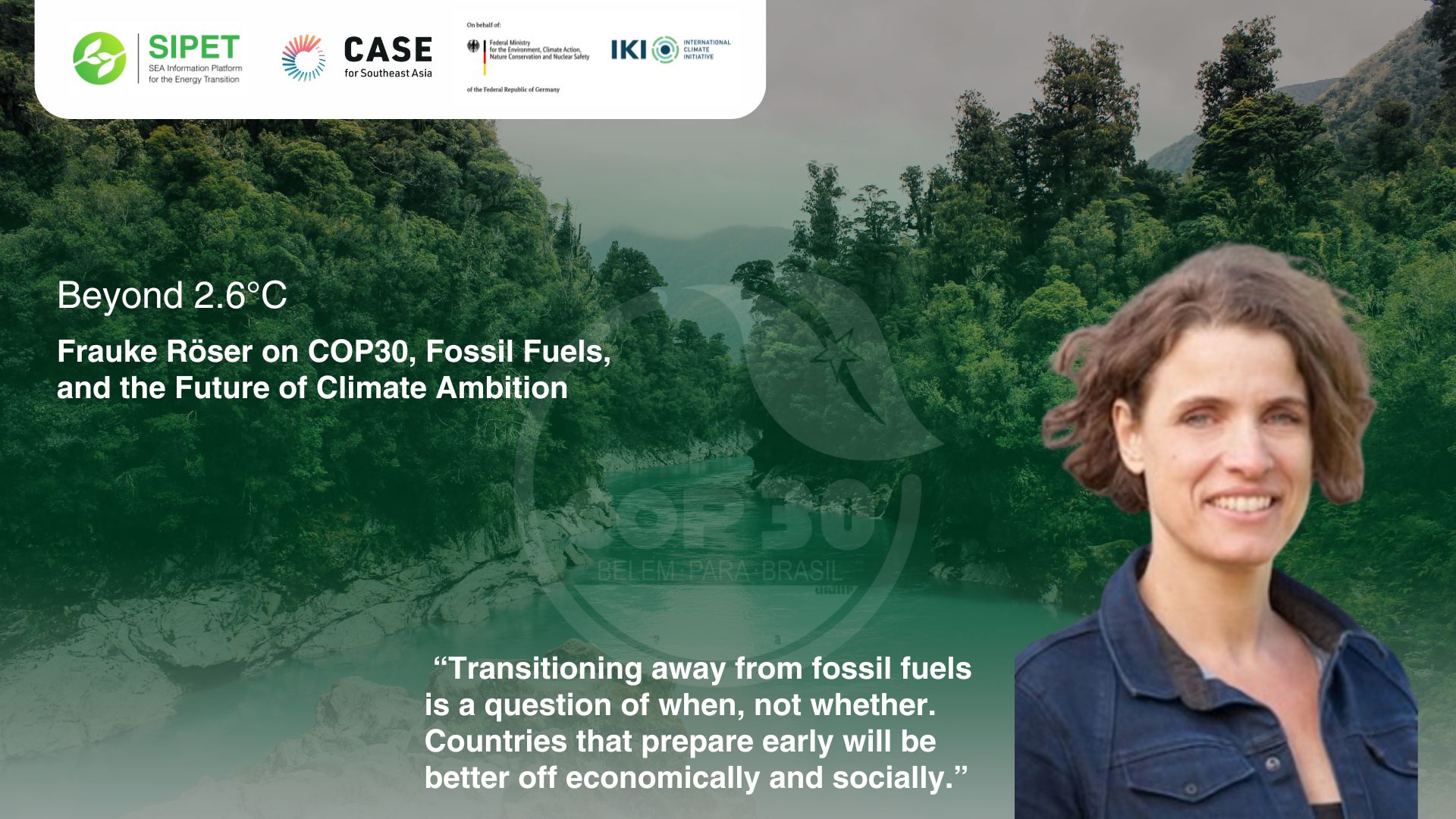
We start with an in-depth interview with Frauke Röser, Co-Founder and Director of NewClimate Institute, who offers a candid insider view of COP30 in Belém and what it means for fossil fuels, just transition, and NDC ambition. Our Explainer then breaks down the key outcomes from COP30, before we shift gears to a year-in-review of SIPET in 2025, from the Transition Finance Series and the new Transition Toolbox to the Power Policy Tracker and other tools helping Southeast Asia’s clean energy transition take shape. 

We also round out this edition with our regular listing of upcoming events and opportunities.  

A Glimpse Inside COP30
Climate negotiators may have left Belém without mentioning fossil fuels in the final COP30 text, but the politics around a phase-out are shifting fast. In this interview, Frauke Röser, Co-Founder and Director of NewClimate Institute, reflects on what COP30 revealed about NDC ambition, the emerging agenda of “transitioning away from fossil fuels”, and why 2.6°C is both alarming and still better than where we were a decade ago. She talks candidly about the limits of the COP process, the growing role of the just transition in negotiations, and the funding squeeze many climate organisations are now facing. Frauke also shares what all this means for governments and investors in Southeast Asia, and why clear, long-term signals still matter for driving real-world change. 

Like what you see so far?

Forward this newsletter to your friends and colleagues. Invite them to join the SIPET community by...

COP30 in Belém

Each year, the UN climate Conference of the Parties (COP) bring nearly all countries together to negotiate how the world responds to climate change. COP30, held in Belém, Brazil, took on added symbolic weight: a summit in the Amazon at a time when climate impacts, from extreme heat to torrential rain, are becoming harder to ignore. It also landed ten years after the Paris Agreement, with governments under pressure to show whether they are really bending the global temperature curve. 

Key takeaways from COP30

  • “Global Mutirão” / Belém Package adopted 
    Countries agreed on a political package known as the Global Mutirão or Belém Package, which reaffirms the Paris Agreement and bundles decisions on mitigation, adaptation, finance, and implementation. The Belém Package reaffirmed a global goal to mobilize at least USD 1.3 trillion per year by 2035 from public and private sources for climate action in developing countries.  
  • Adaptation finance to be tripled by 2035 
    Parties agreed to triple adaptation funding for developing countries by 2035, with UN reports framing this as a step-change in support—though many observers note the timeline is late and the text lacks clear obligations on who pays and how. 
  • Just Transition Mechanism launched 
    COP30 established a Just Transition Mechanism and related work programme, putting workers, communities, and social protections more firmly into the UN climate process, as countries shift away from high-carbon activities. Business and civil society groups welcomed the signal but stressed that finance and concrete national plans now need to follow.  
  • No binding fossil-fuel phase-out roadmap in the core decision 
    More than 80–90 countries pushed for strong language and a roadmap to phase out fossil fuels, but opposition from major producers meant the final Mutirão decision contains no explicit fossil-fuel phase-out. Instead, countries agreed to prepare non-binding roadmaps and coalitions outside the formal COP text, including work on “transitioning away” from fossil fuels. Additionally, an event is being prepared by Colombia and the Netherlands to convene a conference on this topic in April.  
  • COP30 strengthened process and advanced select agenda items, while leaving open questions on overall impact. 
    COP30 preserved cooperation under the UN climate process and moved forward elements on adaptation, just transition, forests, and finance. However, a number of analyses point to remaining gaps between current commitments and pathways consistent with 1.5°C, and note that further work is needed to translate signals into clearer timelines and implementation—particularly on the energy transition. 
In 2025, SIPET continued to grow as a regional hub for people who need clean energy information they can actually use. Through monthly SIPET Connect editions, explainers, and interviews, we tracked the big themes shaping Southeast Asia’s transition—from donor coordination and national reforms to civic movements and regional power-grid momentum. Along the way, we kept expanding the platform so it’s easier to find projects, policies, and stories in one place. 
 Talking Transition Finance
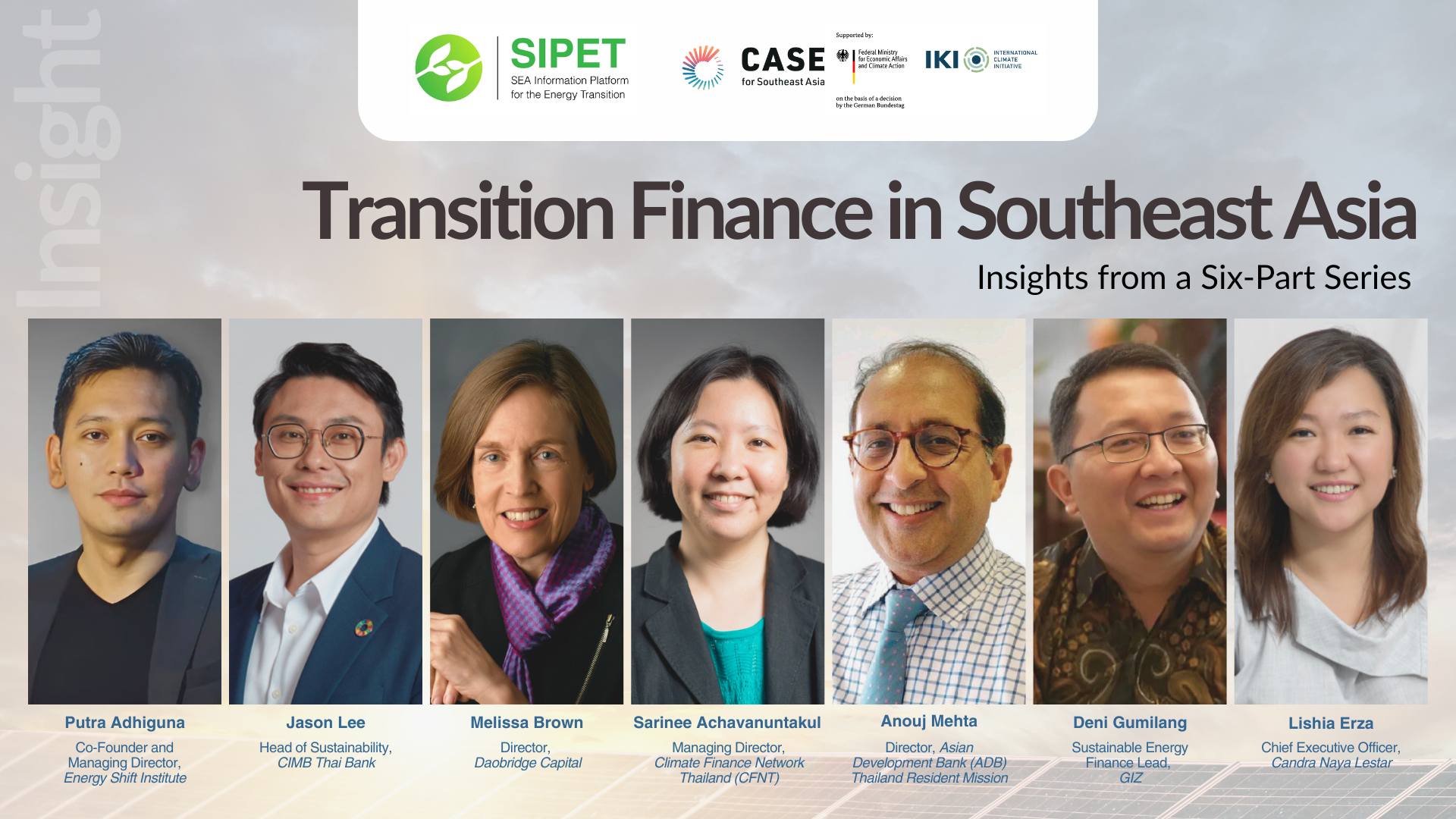
This year we ran a dedicated Transition Finance Series—a multi-part set of conversations exploring how finance can support credible, time-bound decarbonization in high-emitting sectors across Southeast Asia. The series unpacked what “transition finance” means in practice, what good looks like, and where the risks and gaps still are for banks, DFIs, policymakers, and businesses.

We brought it all together in a final wrap-up piece, which you can read here
 Enters the Transition Toolbox series
Building on that momentum, we launched the Transition Toolbox series—deep-dive interviews into practical tools, policies, and convening formats that are already working on the ground. Each edition zooms in on one concrete approach (from regional power grids and low-carbon cities to new dialogue formats and civic movements) and unpacks how partners are making it work in real-world conditions.

You can find the Transition Toolbox conversations in our articles and blogs section (look for pieces tagged “Transition Toolbox”), and we’ll keep adding to the series in 2026 with more voices from governments, cities, financiers, and civil society. 
 
Tools you can actually use
A big milestone this year was the launch of the Power Policy Tracker, developed under CASE and hosted on SIPET. The tool gives a comparative overview of energy-transition policies across ASEAN—covering renewable power targets, grid development plans, and EV ambitions—so users can quickly see who is doing what, and how ambitious they are. 
👉 https://www.sipet.org/powerpolicytracker.aspx 

Together with our existing tools, SIPET now offers a compact toolkit for anyone tracking the transition: 

  • Project Mapping Tool – A regional database of clean-energy and transition projects, helping users spot gaps, overlaps, and potential partnerships. 
  • Power Sector Data Browser – A simple way to explore generation mix, capacity, and demand data across Southeast Asia’s power sectors. 
  • Power Sector Snapshots – Visual country one-pagers that make it easy to brief colleagues or partners on a national power system in minutes. 
  • Power Policy Tracker – A comparative view of policies and targets across ASEAN, from renewables and grids to electric mobility. 
  • Knowledge Hub – Curated interviews, explainers, reports, and resources—where all of this year’s Transition Finance and Transition Toolbox content lives.
 Where SIPET Showed Up This Year 

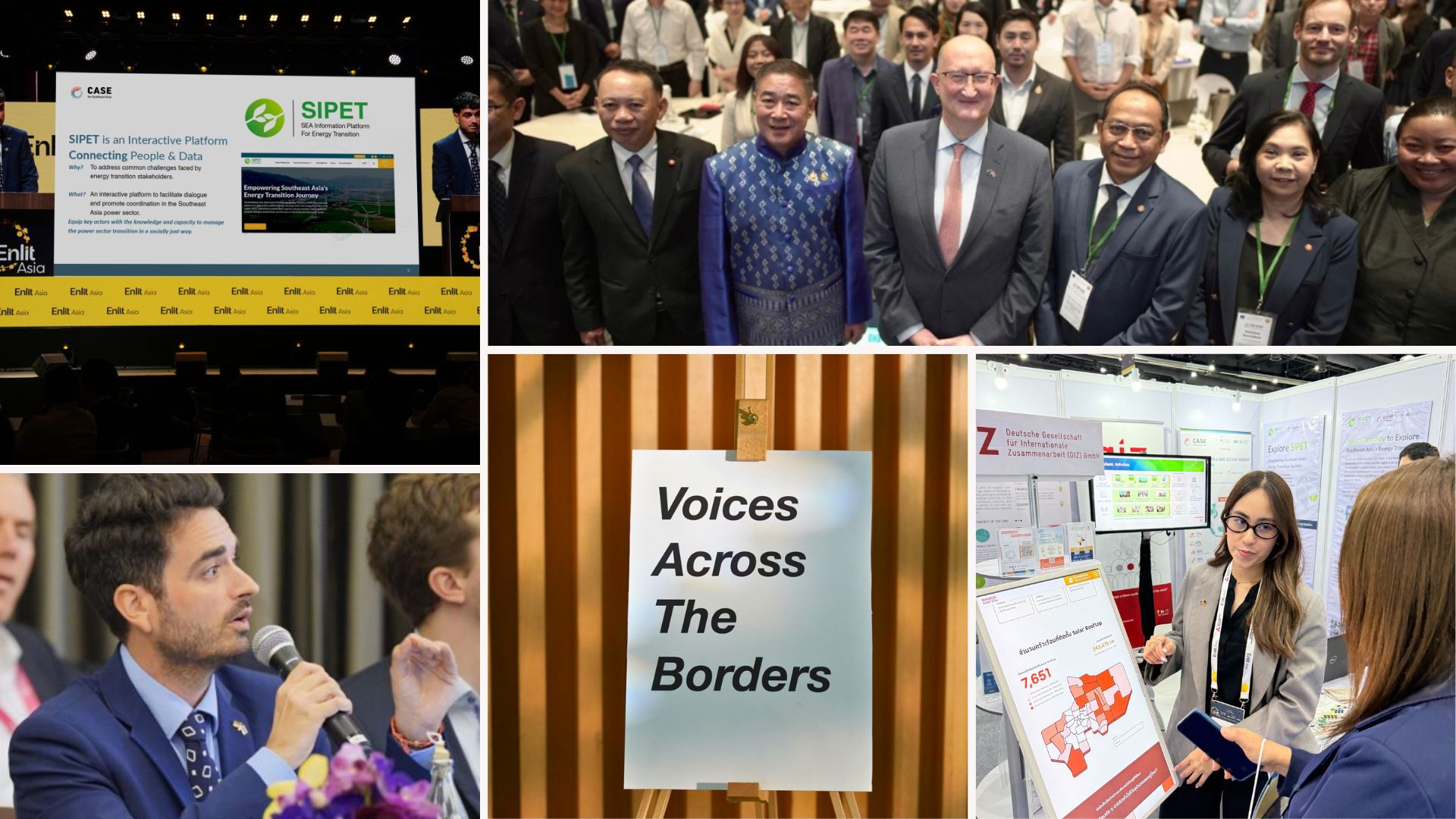
SIPET also showed up more visibly in regional conversations this year. We helped introduce the Power Policy Tracker at the Asia Clean Energy Forum (ACEF) 2025, supported its launch webinar with CASE partners, and featured it in the June SIPET Connect edition. We shared tools and stories through partner channels at Enlit Asia 2025, Bangkok Climate Action Week, and also Singapore International Energy Week, where SIPET joined as a media partner. 

 What’s Next for 2026 

In 2026, we’ll keep building on what worked in 2025: more Transition Toolbox conversations, deeper use of the Power Policy Tracker and the Project Mapping Tool in country work, and new Explainers on the topics our community keeps talking about. If you’re using SIPET in your work or want to co-create new tools or stories, we’d love to make next year’s editions reflect your questions and experiences even more. 


SIPET Noticeboard

Looking to grow your career or stay ahead in Southeast Asia’s clean energy sector? This section features curated job openings and key upcoming events. Discover roles that align with your goals and events that keep you informed, connected, and inspired.

Jobs   

⏺ GIZ Thailand  

Communications Officer Clean, Affordable and Secure Energy for Southeast Asia (CASE)- Bangkok 

⏺ EMA 

Analyst / Senior Analyst (International Relations/ ERD) - Singapore 

⏺ New Energy Nexus 

Thailand Country Manager - Thailand 

⏺ Accenture 

Environmental Sustainability Senior Analyst – Philippines  

⏺ Schneider Electric 

Energy Efficiency Specialist – Thailand 


⏺  Arup 

Senior Environmental Consultant - Philippines 

⏺  Global Wind Energy Council (GWEC) 

Regional Programme Manager - Singapore
 
⏺ The Global Energy Alliance for People and Planet (GEAPP) 

Country Lead - Indonesia 

Events   

⏺ 2nd Annual Vietnam Offshore Wind Roundtable | Ho Chi Minh City| 15 January 2026| Register Here 

⏺ 4th World Hydrogen Conference ASEAN 2026 | 28-29 January 2026| Bangkok| Register here 

⏺  Renewable Energy Markets Asia 2026 \ 21-22 April 2026 | Singapore | Register Here 


Want to highlight energy transition jobs and opportunities to a community of Southeast Asia’s clean energy professionals?

Click here to share your job openings and opportunities, and tap into our growing network of experts, practitioners, and decision-makers across the region and beyond.

Call for Stories of Change!

Know a good story of impact you want to share? Submit your story here t
o be featured in the next SIPET newsletter!
Your Reading List
ABOUT CASEThe Project "Clean, Affordable, and Secure Energy for Southeast Asia (CASE)" aims to shift the energy sector narrative in Southeast Asia towards an evidence-based clean energy transition, with the aim to increase political ambition to comply with the Paris Agreement. SIPET is part of an effort by CASE to accomplish the shift of the energy sector narrative by supporting: (a) research and evidence, (b) transparency and mapping, (c) dialogue with non-energy sector stakeholders, (d) technical assistance on clean energy, and (e) promoting public discourse on the energy transition.CASE is funded by the German Federal Ministry for Economic Affairs and Climate Action (BMWK), and jointly implemented by the Deutsche Gesellschaft für Internationale Zusammenarbeit (GIZ) GmbH and international and local expert organisations in the area of sustainable energy transformation and climate change: Agora Energiewende and NewClimate Institute (regional level), the Institute for Essential Services Reform (IESR) in Indonesia, the Institute for Climate and Sustainable Cities (ICSC) in the Philippines, the Energy Research Institute (ERI) and Thailand Development Research Institute (TDRI) in Thailand.
Southeast Asia Information Platform for the Energy Transition (SIPET)c/o Clean, Affordable, and Secure Energy (CASE) for Southeast Asia

193/63  Lake Rajada Office Complex, 35th floor, New Ratchadapisek Road, Klongtoey, Bangkok 10110, Thailand

Reach out to us:

Website: https://www.sipet.org  | Email: info@sipet.org | LinkedIn: Southeast Asia Information Platform for the Energy Transition - SIPET

You are receiving this newsletter based on your past interest in events hosted by CASE and SIPET.Consider sharing this with colleagues who might want to SUBSCRIBE TO SIPET CONNECT NEWSLETTER.If you wish to unsubscribe and no longer receive these updates, please click this link.
 
 
GIZ GmbH
Maximilian Heil
Dag-Hammarskjöld-Weg 1-5
65760 Eschborn
Deutschland

+49 61 96 79-0
maximilian.heil@giz.de