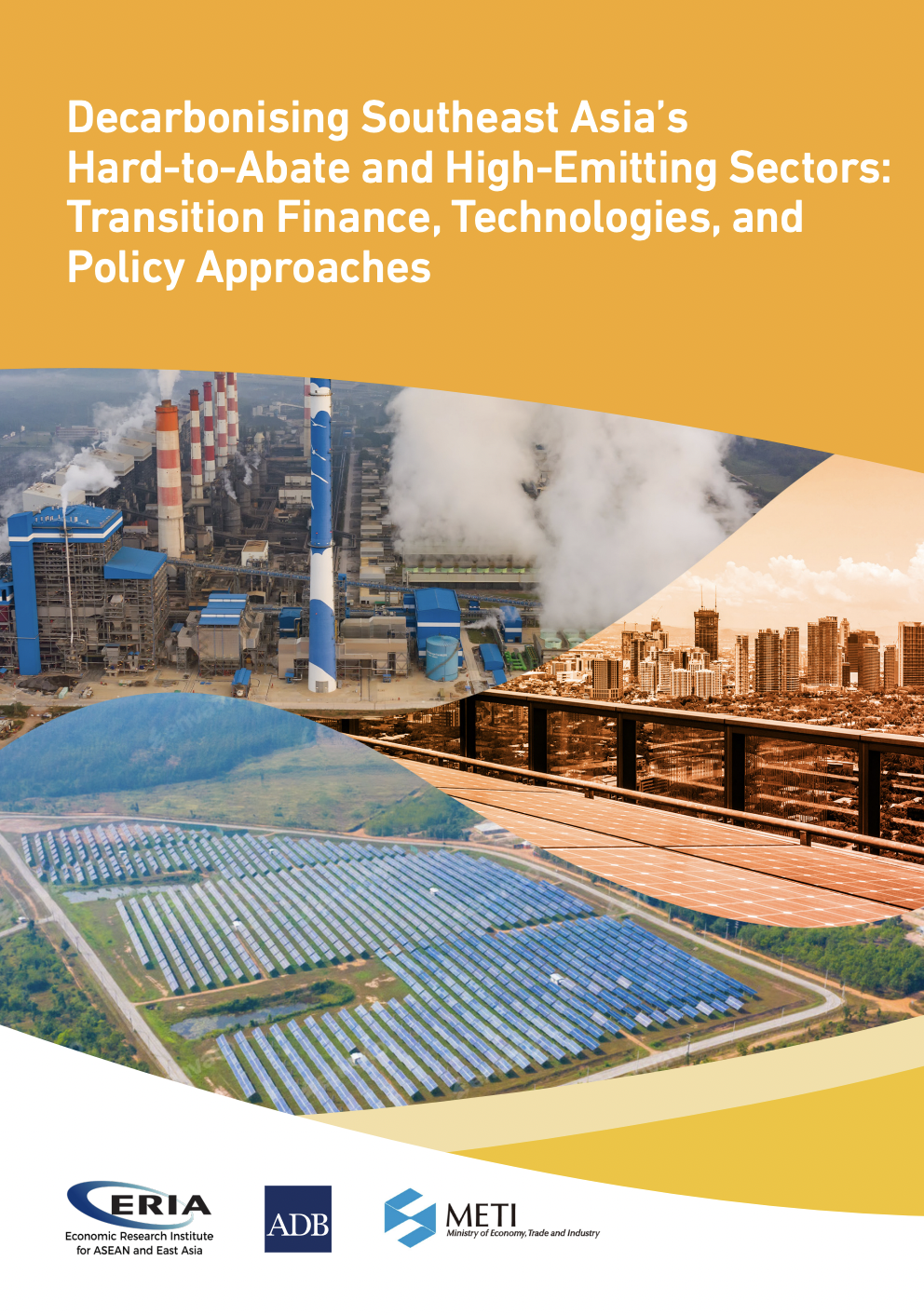
Southeast Asia’s economy is growing fast, and so are its emissions. Power and heavy industry together account for more than 70% of the region’s projected emissions, driven by young coal fleets and energy-intensive industries such as cement, steel, and chemicals. Decarbonising these “hard-to-abate” and high-emitting sectors is essential if ASEAN countries are to meet their climate goals while keeping energy secure and affordable. A new ERIA–ADB report maps out what this transition could look like in practice, focusing on technologies, finance, and policy reforms that can bend the curve.
Unlike sectors where clean solutions are already mature, these industries face steep technical and financial barriers: relatively new fossil assets, long-term contracts, and still-expensive options like green hydrogen, CCUS, and deep industrial electrification. The report positions transition finance as a bridge between today’s fossil-heavy reality and a low-carbon future—supporting credible brown-to-green pathways backed by clear roadmaps, safeguards against greenwashing, and strong governance. It calls for integrated power and industry planning, regional power interconnection, carbon pricing, subsidy reform, and blended finance to make first-of-a-kind projects bankable and scalable, while ensuring the shift is just and inclusive for workers, communities, and SMEs.
|